

An estimate form, inbox confirmation, garage acceptance, and an agreed appointment are separate stages. Use this evidence checklist to confirm the time, quote scope, repair authorization, cancellation terms, and what to bring before Shaken day.
General preparation guidance for private passenger cars. This is not a vehicle diagnosis, confirmed quote or available appointment.
Five checks for your next step.
Tick the items you have checked and identify the next question. Progress lasts while this page stays open and is not submitted.
0 / 6 items organized
These ticks are preparation notes, not official verification, identity checks or booking confirmation.
Related area and preparation resources
The direct answer: a submitted form is not a confirmed booking
Submitting a Shaken estimate form normally does not confirm an appointment. It creates an inquiry that someone still has to review. A useful way to prevent misunderstandings is to separate four events: the request was recorded; the email address or contact route was confirmed; a garage accepted the vehicle and requested conditions; and the customer and garage agreed on a date, time, work scope, and practical terms. A reference number or automated reply can prove that a system received data, but it does not by itself reserve workshop capacity.
Treat the booking as confirmed only when the evidence identifies the actual provider, location, vehicle, appointment date and time, and the action expected from you. It should also explain whether the number shown is a preliminary estimate or a confirmed price, what remains subject to physical inspection, and how additional work will be authorized. If a loaner car, collection service, waiting appointment, same-day completion, or special payment method matters, that condition needs its own confirmation. A general service description on a national website is not evidence that a particular branch has accepted it for your visit.
Different services use different workflows. An official provider may offer an online estimate request, a real-time booking facility for participating locations, a callback, or a store-specific reservation page. The label on the first button does not establish the final status. Read the response that follows and keep the garage's confirmation. 車検.jp currently provides preparation and comparison tools; it does not represent that its own request form secures a garage slot. The practical goal is to identify the evidence that converts an inquiry into an appointment you can rely on.
Source notes: 楽天Car車検:車検の予約・見積もり(公式) ↗ · オートバックス:車検(公式) ↗

Prepare one complete request before you send it
A garage cannot accept a useful appointment from a vague message such as “I need Shaken soon.” Prepare a compact request using information you can verify: the inspection expiry shown in the vehicle documentation, manufacturer and model, approximate registration year, current mileage, warning lights, known symptoms, preferred area, preferred dates, and a reliable contact method. If you use an electronic inspection certificate, confirm information that is not visible on the card through the official viewing method rather than guessing from memory. You do not need to post a chassis number, home address, or document photograph in a public review or social-media thread.
Separate requirements from preferences. A requirement might be completion before a verified expiry date, access to a loaner under stated insurance conditions, or support for a vehicle that cannot lawfully be driven. A preference might be a Saturday morning, a particular payment method, or a waiting appointment. Tell the garage which is which. If every item is presented as non-negotiable, the provider may be unable to propose an alternative. If none is identified, you may receive a technically available slot that does not solve your actual transport or work problem.
Use the same factual request when comparing providers. This does not mean demanding identical prices before inspection. It means asking each provider to answer the same questions: what is included in the initial amount, which statutory charges are separate, whether a pre-inspection is needed, when a final work scope is approved, and what date is actually available. Note the date and channel of each reply. A concise record is more valuable than a long collection of screenshots without context because it lets you see which promises apply to your specific vehicle and which are only general website descriptions.
Do not conceal a warning light, unusual noise, recent collision, modified equipment, or mobility problem merely to obtain a faster online response. Those facts can affect safety, inspection preparation, parts, expertise, or transport. Honest information improves the chance that the offered appointment is realistic. The provider may still need a physical assessment, and the final quote may change for a documented reason. The purpose of preparation is not to force a guaranteed price; it is to reduce avoidable surprises and allow the garage to decide whether it can accept the work.
Source notes: 国土交通省:車検を受けられる期間の拡大 ↗ · 国土交通省:電子車検証特設サイト ↗
Distinguish an auto-reply, inbox confirmation, and garage acceptance
An automatic reply is useful evidence, but its meaning is limited. It can show when the form arrived, reproduce the details you entered, and provide a reference number. Read the verbs carefully. Received, registered, and we will contact you usually describe intake. They do not necessarily mean accepted, reserved, or confirmed. If the message says that a branch will review availability, the next communication is the one that matters for capacity. Keep the first receipt because it helps the provider locate the request, but do not plan transport around it as if the workshop has approved the visit.
Inbox confirmation is another separate control. Clicking a link may establish that someone can receive mail at the submitted address. It does not verify that the person owns the vehicle, that the self-reported expiry is correct, that the garage has inspected the car, or that marketing permission exists. A responsible service should not convert basic service correspondence into advertising consent without a separate voluntary choice. If you request a reminder or preparation pack, check whether that option is optional and how to stop it later.
Garage acceptance should name the provider responsible for the appointment and connect its response to your vehicle and requested time. Look for a branch name, physical address, date, arrival time or agreed window, and instructions. If a marketplace sends the reply on the garage's behalf, retain the marketplace reference and the garage information. Where the process requires a phone call, treat the call as a stage to complete, not as a confirmed result merely because you requested it. After a call, ask for written confirmation through the provider's normal channel when possible.
If messages conflict, use the latest explicit confirmation and ask the official provider to resolve the inconsistency. Do not rely on a search-result snippet, an AI answer, an old cached page, or a social-media comment for live capacity. Those sources may help you discover a provider, but only the provider's current system or authorized staff can confirm that the requested slot is held. Record the name or department, date, and conditions without collecting unnecessary personal details about an employee.
Source notes: 楽天Car車検:車検の予約・見積もり(公式) ↗ · オートバックス:車検(公式) ↗

Nine details your booking evidence should contain
Reliable booking evidence should answer nine practical questions. First, which legal business or branch will receive the vehicle? Second, where is the arrival point? Third, on what date and at what exact time or defined arrival window? Fourth, which vehicle is the booking for? Fifth, is the visit for a preliminary estimate, an inspection service, a reinspection, or another scope? Sixth, which documents and items should you bring? Seventh, which costs are fixed, estimated, statutory, or subject to inspection? Eighth, how do changes and cancellations work? Ninth, what happened to any special request such as a loaner, collection, waiting space, or accessibility need?
The answers can be spread across a confirmation page, email, and branch-specific terms. Save them together with the same reference number. Take a screenshot or export a receipt when the provider allows it, but also preserve the page URL and date because screenshots can omit conditions. If the provider has an account dashboard, check the status there before the visit. Do not publish the receipt: it may contain contact details or a reservation identifier that should remain private.
Price language deserves careful reading. A preliminary amount may assume a vehicle class, weight, no additional repairs, or a particular payment method. Statutory charges and service fees have different purposes. Ask whether the displayed amount includes the compulsory insurance, weight tax, inspection or registration-related fees, basic workshop charge, inspection preparation, parts, disposal fees, substitute transport, and taxes. You are not demanding that every provider use identical labels. You are building a comparison that prevents one broad total from being compared with another figure that excludes major components.
Finally, verify what the time means. It might be an arrival time for a preliminary check, a vehicle drop-off window, or the start of a waiting service. It may not be a promised completion time. If completion affects work, childcare, travel, or insurance, ask for the expected handover process and how delays will be communicated. A credible answer may include uncertainty. We will update you after the initial inspection is more useful than an unsupported promise that every vehicle will be finished at the same hour.
Source notes: オートバックス:車検(公式) ↗ · 国土交通省:車検を受けられる期間の拡大 ↗
Separate statutory charges, base service, and repair work
A Shaken quote is easier to evaluate when it separates categories rather than presenting one dramatic headline number. Statutory items can depend on the vehicle and current official rules. Workshop charges cover the provider's service and process. Repairs and parts depend on actual findings. Ask the provider to identify those categories in its own terminology and state what is included. A national campaign page may show an example or starting point, while a branch quote may apply conditions such as vehicle class, advance booking, membership, payment type, or excluded repairs.
Do not compare a base fee from one provider with an all-in preliminary total from another. Normalize the rows first. A useful sheet has columns for the date of the quote, vehicle information used, statutory charges, basic inspection or agency charge, preliminary maintenance, confirmed repairs, optional work, substitute mobility, discounts with eligibility rules, tax treatment, and expiry of the offer. Leave a cell unknown until the provider answers. A blank is more honest than an assumed zero.
Physical inspection can reveal additional work, but that does not require an open-ended authorization. Ask how the garage classifies and communicates findings. One helpful structure is: work needed to address an inspection requirement; work prioritized for safety or reliability; and optional preventive or comfort work. The provider should explain the finding and proposed response. The customer can then ask about parts, labor, timing, alternatives where appropriate, and the effect of declining. This framework is for communication, not a remote diagnosis or an instruction to reject a safety recommendation.
Set an authorization rule before leaving the vehicle. For example, no additional paid work without contact, or a clearly stated maximum for specified minor items. Confirm which channel will be used and what happens if you cannot be reached. Ask whether diagnostic or dismantling charges apply even if later work is declined. If the initial quote changes, request an updated breakdown before approval. The goal is not merely to find the lowest figure; it is to make sure the accepted scope, price, and responsibility are visible enough that the final invoice can be reconciled with the agreement.
Source notes: 楽天Car車検:車検の予約・見積もり(公式) ↗ · オートバックス:車検(公式) ↗ · 国土交通省:電子車検証特設サイト ↗
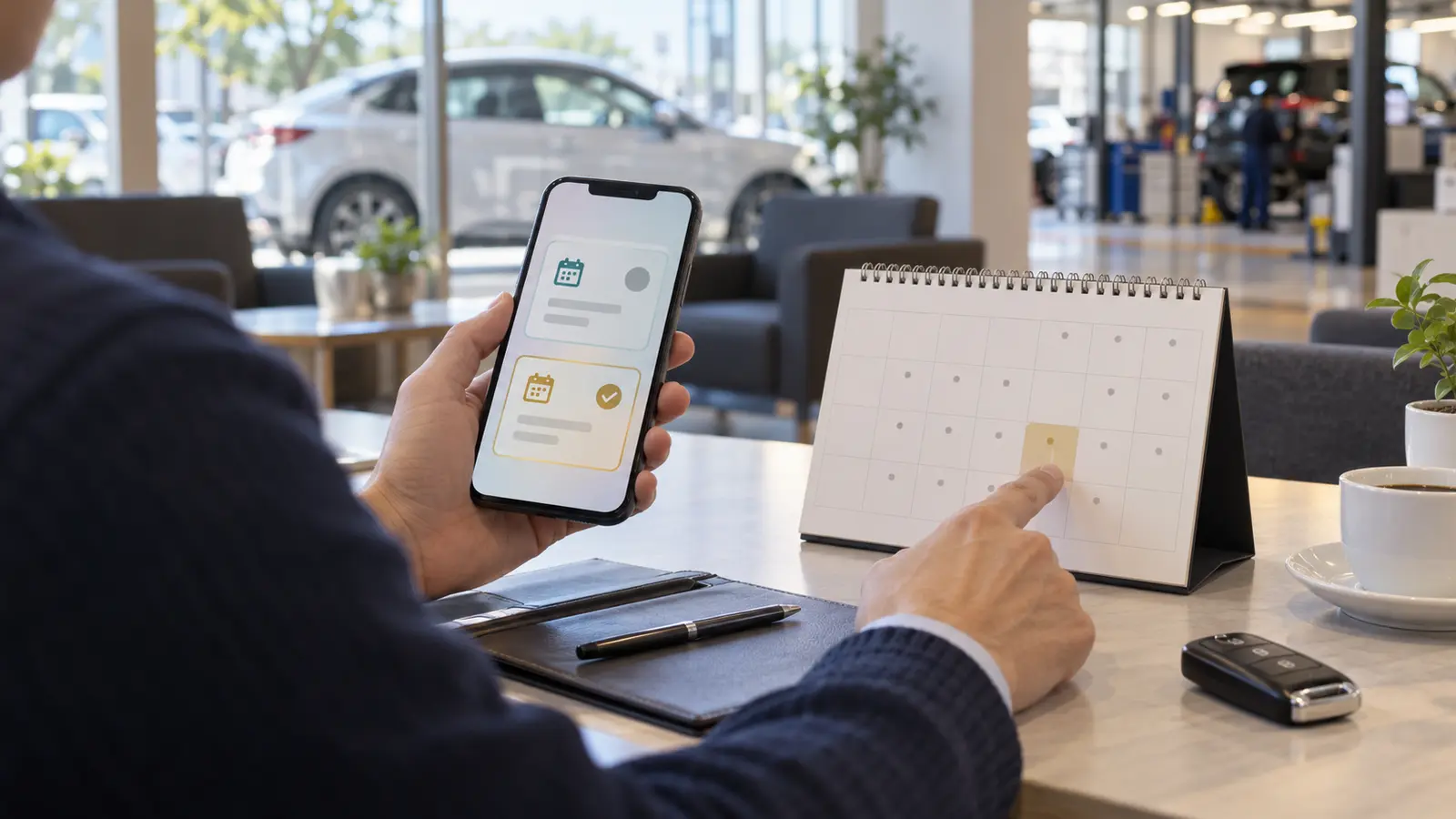
Confirm loaner, collection, cancellation, and payment conditions separately
A service icon saying loaner available does not prove that a suitable car is reserved for your dates or free under every condition. Ask whether a separate reservation is required, who may drive, which license conditions apply, what insurance and customer liability apply, how fuel and tolls are handled, and when the vehicle must be returned. If child seats, accessibility, winter tires, cargo capacity, or other features matter, ask specifically. Do not assume the substitute vehicle matches your own car.
Collection and delivery also need a defined scope. Confirm the service area, fee, identity checks, handover record, keys, existing damage record, valuables, and the point at which responsibility transfers. A marketplace description may not apply to every branch. If a third party performs transport, ask who it is and which contact handles a delay or incident. Never leave keys or documents based only on an unsolicited message; use the provider's verified official contact route.
Cancellation terms can change once parts have been ordered or external services arranged. Identify the deadline, correct contact route, any charge, and what happens after a missed arrival. If the garage proposes an earlier preliminary visit, clarify whether canceling that visit also cancels the main appointment. Keep the cancellation confirmation just as you kept the booking confirmation. A request sent outside business hours may not be processed immediately, so do not assume a form submission has changed the reservation until the provider acknowledges it.
Payment requires similar care. Ask which methods apply to statutory charges and which apply to workshop fees, because they may not be identical. Confirm when payment is due and whether installments, cards, points, or campaign benefits have conditions. Never send card credentials or banking secrets by ordinary email because a message asks you to secure the slot. Use the provider's official payment process. If the final invoice differs, compare it with approved changes and ask for clarification before treating every difference as either automatically valid or automatically fraudulent.
Source notes: オートバックス:車検(公式) ↗ · 国土交通省:車検を受けられる期間の拡大 ↗
If expiry is close or has passed, solve lawful transport before the booking
When the expiry is approaching, verify the exact date from the vehicle documentation and provide that date to the garage. Do not infer it from the month of a reminder postcard, a previous payment, or a postal code. MLIT explains that, from April 2025, the period in which an inspection may be completed without shortening the next validity period was expanded to two months before expiry. That wider window can create time for a preliminary check, parts planning, quote comparison, and a possible reinspection. It does not guarantee that a provider has capacity, so start with evidence rather than waiting for a last-day offer.
If the inspection has already expired, do not drive the vehicle on public roads merely because you submitted a booking request. First solve lawful transport. Depending on the circumstances, that may involve a carrier or a municipal temporary operating permit for a limited authorized purpose and route. The Yashio City official guidance, for example, describes an application process, a limited validity period, required documentation, and valid compulsory automobile liability insurance covering the permitted period. Your municipality's current rules and the actual journey must be checked; one city's page is not a nationwide permit issued by an article.
Compulsory automobile liability insurance is a separate requirement from the inspection certificate. MLIT warns that operating without valid compulsory insurance is prohibited and subject to penalties. A temporary plate is not a substitute for insurance and is not general permission to use the car. Confirm the vehicle identity, intended route, purpose, insurance period, application office, opening hours, fee, and return process directly with the municipality. Weekend or holiday timing can be especially important because an office may not issue a permit when you want to travel.
Tell the garage that the vehicle cannot be driven normally and ask which delivery methods it can receive. Confirm the arrival arrangement before booking a carrier. If the provider cannot accept the vehicle on the proposed day, a transport reservation alone does not create workshop capacity. The safe sequence is: stop unauthorized driving, verify official requirements, obtain a garage's acceptance, arrange compliant transport, and keep each confirmation. Urgency should make the evidence chain clearer, not encourage a shortcut that creates legal or safety risk.
Source notes: 国土交通省:車検を受けられる期間の拡大 ↗ · 八潮市:自動車臨時運行許可(仮ナンバー) ↗ · 国土交通省:自賠責保険・共済 ↗

Three worked examples show how the status changes
Example one: Mika submits a national estimate form at 22:00 and immediately receives Your request has been received; the store will contact you. The receipt includes her chosen branch and preferred Saturday. This is useful intake evidence, but the branch has not accepted the time. Mika keeps the reference, waits for the official reply, and does not yet cancel work or book a rental car. The following morning the branch offers a different Saturday and asks for a preliminary visit. Only after she accepts and receives the appointment details does she treat that visit as confirmed.
Example two: Ken uses a provider's real-time booking page for a participating store. The final screen names the branch, vehicle, date, arrival time, and reservation number. The loaner field says contact store. Ken has stronger evidence that the appointment is booked, but no evidence that a loaner is reserved. He contacts the branch through the official route and receives separate terms covering driver eligibility, insurance, fuel, and return time. He records the appointment and loaner as two statuses rather than treating one confirmation as proof of both.
Example three: Aya agrees to a date by phone after describing a warning light. The garage confirms that it will first assess the vehicle, but the quoted online starting price is not a final repair total. Aya asks for a written note stating the appointment purpose, initial charge, and the rule that paid additional work requires her approval. The booking can be confirmed while the final work scope remains open. This is not a contradiction: appointment status and quote status answer different questions.
These scenarios are planning examples, not reports of actual customers or partner garages. Their lesson is that a process can be partly confirmed. Instead of asking only whether everything is booked, ask which elements are confirmed and which still need action. A short status list—request received, inbox confirmed, garage accepted, time agreed, quote scope recorded, mobility arranged—makes the next task visible. It also gives a provider a precise question to answer instead of forcing it to interpret a broad complaint after the vehicle arrives.
Source notes: 楽天Car車検:車検の予約・見積もり(公式) ↗ · オートバックス:車検(公式) ↗
Run a final check the day before and on arrival
The day before, open the current confirmation rather than relying on memory. Verify the branch address, entrance instructions, arrival time, provider contact, and documents requested for your case. Commonly requested items may include the inspection certificate and compulsory insurance certificate, along with vehicle-specific items the garage identified. Tax-payment verification may be electronic in applicable situations, but exceptions can require documentation; ask the provider rather than assuming an old checklist is universally correct. If the vehicle uses locking wheel nuts, mention the key. Remove valuables and unrelated personal information.
Report a new warning light, impact, noise, flat battery, or mobility problem before setting off. A condition that changed after booking can affect safety, transport, or work scope. Do not clear a warning merely to make the dashboard look different for arrival. If you are delayed, use the branch's official contact. An online request to change a time is not effective until the provider acknowledges it under its process.
At handover, confirm what the garage is taking custody of: vehicle, keys, documents, accessories, and any pre-existing condition it records. Review the purpose of the visit, preliminary amount, unknown items, communication channel, approval threshold, and expected update. If another person will authorize work or collect the vehicle, confirm the provider's identity and authorization requirements. Keep sensitive documents within the provider's instructed process instead of sending copies to an unrelated address.
At collection, reconcile the approved scope with the invoice and explanation. Ask what was inspected, what was replaced or adjusted, which recommendations remain, and which records you receive. Check return of documents, keys, removed personal items, and any agreed loaner process. This final review is not an accusation; it is the last link in the evidence chain. A well-documented completion helps you distinguish a completed inspection service from a request, estimate, preliminary visit, or pending repair.
Source notes: 国土交通省:電子車検証特設サイト ↗ · 国土交通省:自賠責保険・共済 ↗

FAQ: estimate requests and confirmed bookings
Does an automatic reply mean I am booked?
Read the actual status language. A message saying received, registered, or awaiting store contact normally records an inquiry. Look for a provider-specific acceptance that identifies the branch, vehicle, date, time, and next action before treating it as a booking.
Is a reference number enough to arrive at the garage?
Not necessarily. A reference helps the provider find the request but may not represent workshop capacity. Confirm that the garage accepted the request and gave you an arrival time. If the reply says it will contact you, complete that step first.
Does clicking an email link verify me and my vehicle?
Usually it verifies access to the inbox used for the request. It does not by itself verify identity, ownership, driving authority, inspection expiry, or vehicle condition. Those questions may require separate documents or examination through the provider's process.
Is the online price guaranteed?
Only if the provider explicitly says so for your vehicle and conditions. Starting prices, examples, and preliminary estimates can exclude statutory items, repairs, special parts, or conditional discounts. Ask for an itemized explanation and identify what can change after inspection.
Does loaner available mean a free car is reserved?
No. Confirm inventory for your date, charge, driver rules, insurance, customer liability, fuel, mileage, return time, and special equipment. Keep a separate loaner confirmation instead of inferring it from the inspection booking.
Can a garage perform additional repairs without asking?
Establish the authorization rule before handover. Ask how findings will be explained, which contact will be used, whether any limited threshold applies, and what happens if you cannot be reached. This does not override urgent safety handling or the provider's lawful responsibilities.
Can I drive an expired-inspection vehicle because I have an appointment?
No. An appointment does not authorize public-road use. Stop ordinary driving and check compliant transport, valid compulsory insurance, and any municipal temporary-permit conditions with the official authorities and garage.
What if the store and marketplace show different dates?
Contact the provider through its official route, quote the shared reference, and ask which date is currently held. Keep the resolving message. Do not choose the more convenient screen without confirmation.
Should I send my vehicle documents by ordinary email?
Send only information required through the provider's instructed secure or official channel. Avoid public posts and unsolicited addresses. Ask why a copy is needed and protect unrelated personal details.
Does a reservation confirm the final total?
Not necessarily. A booking can be confirmed while the final repair scope remains subject to physical inspection. Record the preliminary amount, unknowns, and additional-work approval process separately.
Does 車検.jp currently book a partner garage when I submit its estimate form?
No. Its current form is a preparation and intake tool and does not claim a garage slot, confirmed quote, discount, or accepted referral. Use the private receipt to manage the request and contact an official provider to secure an appointment.
What is the quickest reliable final check?
Open the latest provider confirmation and verify branch, address, date, time, vehicle, purpose, documents, quote status, mobility arrangement, and change contact. If one critical item is missing, ask a specific question and wait for the provider's acknowledgement.
References and primary sources
Checked: 2026-10-06. Confirm current procedures, prices and conditions with the official source and workshop. Hypothetical amounts and scenarios are not market-price guarantees or customer results.
- 楽天Car車検:車検の予約・見積もり(公式) ↗
- オートバックス:車検(公式) ↗
- 国土交通省:車検を受けられる期間の拡大 ↗
- 国土交通省:電子車検証特設サイト ↗
- 八潮市:自動車臨時運行許可(仮ナンバー) ↗
- 国土交通省:自賠責保険・共済 ↗
General preparation guidance. This is not an individual vehicle assessment. See our editorial policy for sources and corrections. Editorial policy →
Turn the guide into a plan.
Organize confirmed conditions and prepare the questions for your workshop.
Open the free tool