
Check OBD eligibility, prepare a safe warning-light history, separate inspection and diagnostic charges, and know what to ask before the workshop visit.
General preparation guidance for private passenger cars. This is not a vehicle diagnosis, confirmed quote or available appointment.
Start with safety before the booking
When a warning appears, the first question is what to do safely, not whether the car will pass shaken. Follow the vehicle’s own handbook and seek professional assistance if the situation is unclear. If you notice abnormal behavior while driving, stop in a safe place before trying to record or investigate it. A color alone is not enough to identify every warning or decide that continued driving is acceptable. Different symbols, messages, and vehicle systems require different responses.
This guide helps owners prepare information and arrange an appropriate workshop conversation. It does not diagnose a fault from an illustration, establish that a vehicle is safe to drive, or promise an inspection result. It also does not provide methods for hiding warning lights or clearing fault records to obtain a pass. A useful starting point is a factual account of what appeared, when it appeared, and what the car was doing. That gives the person assessing the vehicle something more reliable than a guess about which component must be broken. If there is an immediate safety concern, obtaining help takes priority over completing any online planning form.
Source notes: JAF:警告灯・表示灯・メッセージ ↗
What OBD inspection adds
MLIT describes OBD inspection as a way to check electronic systems that conventional inspection methods could not fully assess. For vehicles within scope, the process uses inspection equipment to check relevant fault information. A code shown by a consumer application should not be treated as an official inspection result. The purpose, equipment, and interpretation are not interchangeable simply because both involve the vehicle’s diagnostic connector.
As an owner, you do not need to memorize the technical architecture to prepare well. You need to know whether your vehicle is within scope, what the workshop proposes to do, and how that work is described in the estimate. If a line says electronic diagnosis, ask whether it means the required inspection procedure, a separate investigation of a symptom, or another service. Writing down the answer helps you compare quotes that use different terminology. It also prevents a misunderstanding in which you expect a complete explanation of an intermittent fault from a charge that covers only a defined inspection step. Clear language is more valuable than a long list of technical abbreviations you cannot relate to the actual work.
Source notes: 国土交通省:自動車の電子的な検査(OBD検査) ↗
Do not decide eligibility from model year alone
The official introduction dates differ between domestic and imported vehicles. OBD inspection began for relevant domestic vehicles in October 2024 and for relevant imported vehicles in October 2025. Eligibility is tied to the applicable vehicle and type information, not simply the year you bought the car. Check the OBD inspection notation in the vehicle record and have the workshop confirm whether the inspection is required for this visit.
The same model name can cover different versions and introduction dates. A friend’s experience with a car bearing the same badge may therefore be a poor basis for your own booking. Official guidance also describes timing exceptions, so a notation should be read together with the current eligibility check rather than as a shortcut around it. Prepare the model code and registration information the workshop requests. If you are uncertain, say that explicitly instead of selecting an unsupported answer on a form. An accurate unknown is easier to resolve than an incorrect assumption that later changes the appointment, the estimate, or the equipment the branch needs to arrange.
Source notes: 国土交通省:OBD検査とは・ユーザー向け ↗ · NALTEC:OBD検査の対象車と制度 ↗
Prepare the relevant vehicle record
Gather the current vehicle information before you call. The model name is useful, but the workshop may also need the model code, first registration details, and expiration date to identify the correct vehicle and appointment requirements. If you are unsure how to read an electronic inspection certificate, use the official vehicle-certificate guidance or ask the branch which information it needs. Do not substitute an old copy simply because it is easier to find.
Keep document sharing proportionate to the task. Ask whether a particular field is sufficient before sending an entire image that includes personal details. Use the workshop’s established contact channel and confirm the recipient if someone asks you to send documents to a different address. Public social posts and review comments are not suitable places for registration records. This site’s preparation tools do not perform an authoritative vehicle-by-vehicle eligibility decision from a chassis number. Their role is to organize your questions. A short record of where you checked the information, and when, makes later discussions easier if another household member is responsible for delivering the car or approving the work.
Source notes: 国土交通省:電子車検証特設サイト ↗
Record the warning only when safely stopped
If it is safe to make a record, do so only after stopping. Note the symbol or message, whether it was steady or flashing, and approximately when it appeared. Do not operate a phone while driving to capture a dashboard photograph. You also should not deliberately recreate a worrying situation just to obtain a better description for an appointment form.
Write what you remember in plain language. Perhaps the message appeared after starting in rain, during an ordinary journey, or after a recent service. If you do not know a detail, leave it unknown. Distinguish what you observed from what you suspect: “the light appeared after the visit” is an observation, while “the visit caused the fault” is a conclusion you may not be able to support. If the warning later disappears, record that change as part of the history. Disappearance alone does not establish that the cause has been resolved. A factual timeline helps the workshop decide what to examine and avoids turning an uncertain memory into a confident but misleading diagnosis before anyone has seen the vehicle.
Separate inspection fees from diagnostic work
Ask the workshop to distinguish the OBD inspection charge, investigation of a symptom, repair work, and any follow-up checks. Different businesses may use different labels, so two lines with similar names are not necessarily equivalent services. MLIT directs users to the workshop for the applicable inspection and repair charges. There is no single price in this guide that can replace a vehicle-specific quotation.
For a fault investigation, ask what the initial stage includes and what would trigger an additional charge. Agree on how the branch will obtain your permission before proceeding. Also ask what remains payable if you decide not to authorize the repair after diagnosis. These questions do not imply that diagnostic work should be free; they make the scope understandable. A useful estimate explains what is known now and what may only become clear after examination. Avoid assuming that one displayed code identifies a single component that must be replaced. The workshop’s explanation should connect its findings to the proposed next step, giving you a basis for a decision rather than asking you to rely on a code or a general assurance alone.
Source notes: 国土交通省:OBD検査とは・ユーザー向け ↗
Write a short symptom brief for the workshop
A useful brief can be short. Start with vehicle identification, then describe the display, the circumstances, any changes since it appeared, and your inspection deadline. State what you need from the workshop: advice about transportation, an appointment to investigate the symptom, or clarification of whether the scheduled inspection should be adjusted. That makes the purpose of the contact clear without pretending to know the repair in advance.
For example, an owner might write that a warning appeared during an ordinary journey, the car is now parked, and they want advice before bringing it to an inspection appointment. This is an illustrative communication pattern, not a diagnosis or a report from a real customer. Use your own accurate details. If the branch asks a question you cannot answer, say so. Plain observations such as when the display appeared are preferable to technical language copied from an unrelated forum. Keep a copy of the brief and add the branch’s response separately. You can then share the same information with a second workshop if needed without gradually changing the story as you retell it.
Tell the workshop about connected accessories
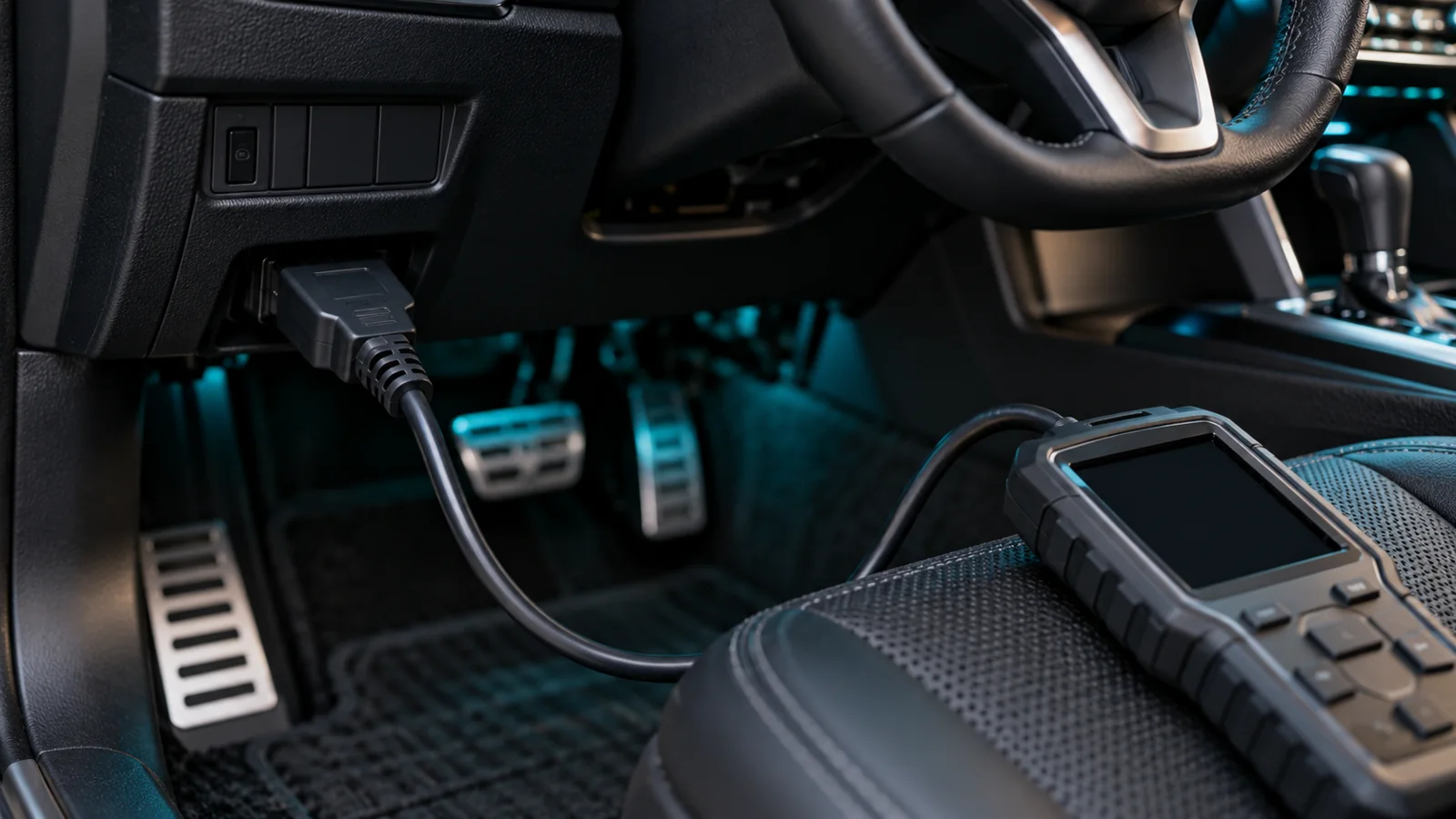
MLIT’s user guidance discusses accessories connected to the diagnostic socket used during inspection. If you do not know how an accessory is connected, ask the installer or inspection workshop for help. Do not pull at unfamiliar wiring or attempt an improvised disconnection based on an image in an article. The goal is to make the required inspection access available safely, with the appropriate person handling any uncertain work.
For your appointment notes, record the accessory name and installation date if you know them. Ask whether any removal and restoration work is included in the booking and whether it carries a charge. This is especially useful when someone else installed a device and you are not familiar with its routing or settings. Tell the workshop about the equipment before arrival so it can plan the visit. Keep this preparation separate from attempts to suppress a warning or alter a diagnostic record. A well-prepared owner provides accurate information about the vehicle as it is; the workshop then decides how to perform the inspection and any necessary investigation using the appropriate procedures.
Source notes: 国土交通省:OBD検査とは・ユーザー向け ↗
Questions for imported, hybrid and electric vehicles
For an imported, hybrid, or electric vehicle, ask about the actual model, version, and work involved. A broad statement that a shop accepts imported cars or EVs does not establish that every diagnostic or repair task can be completed there. Give the branch enough identification information to answer specifically, and ask whether any part of the work would be referred elsewhere.
This is not a guide to inspecting high-voltage components yourself. The owner’s practical role is to prepare records and choose an appropriate service route. Ask how parts delays, specialist work, or an additional appointment would affect the schedule. If you need the car for daily transport, discuss a contingency before leaving it. A quote from a provider that cannot perform the necessary work is not a useful low-price alternative, even if the initial fee looks attractive. Confirm suitability first, then compare the scope and amount. Keep any exclusions in writing so that an acceptance of routine inspection is not later mistaken for agreement to undertake an unrelated or more complex repair.
If the OBD inspection does not pass
If the workshop says the OBD inspection has not passed, ask it to explain the result, the proposed repair, the cost, and the route to a subsequent check. Official guidance says the relevant faults must be repaired for the vehicle to pass. Hiding a result or temporarily making a display disappear is not a substitute for resolving the underlying issue through the appropriate process.
For the decision you need to make, separate confirmed findings from remaining uncertainty. Ask why the proposed work follows from the findings and how the outcome will be checked afterward. If a part must be ordered, discuss the timetable and arrangements for the vehicle while you wait. You may need to consider storage, transport, or a replacement vehicle alongside the repair estimate. Do not assume that an existing appointment changes the inspection expiration date. Keep the explanation and authorization together, especially if several people in the household are involved. A clear record makes it easier to ask for clarification or a second opinion without losing track of what has actually been established.
Source notes: 国土交通省:OBD検査とは・ユーザー向け ↗
Avoid advice that treats clearing a code as a repair
An easy procedure described online is not evidence that it resolves the problem in your vehicle. A warning no longer being visible, a diagnostic record changing, and a fault being repaired are different things. Do not treat them as interchangeable. The purpose of preparation is to provide an accurate history, not to make the car appear trouble-free for a short visit.
If work has already been done, tell the workshop what you know about it. That may include a recent battery replacement, a diagnostic visit, or a previous attempt to address the same symptom. Give dates and documents where available without guessing at technical details you were not told. A clear history helps avoid repeated conversations based on incomplete information. Be cautious about conclusions drawn from a brief social-media clip or a forum post about a different model. You can bring a question from something you read, but let the person examining the car explain whether it applies. This approach supports a better decision while keeping the focus on the vehicle’s actual condition and the work that can be justified.
Leave room in the schedule for investigation
A vehicle with a warning-light concern may need more than the routine inspection appointment you first had in mind. Ask what is known about the timing of initial investigation, estimate discussion, parts supply, and follow-up checks. If the branch cannot yet give a completion date, record that as an uncertainty rather than converting a hopeful estimate into a fixed promise in your calendar.
Prepare a preferred day and at least one fallback where possible. If a replacement vehicle is essential, ask about availability and conditions before confirming the visit. Explain the symptom even if you are attracted by an advertised short inspection format. Leaving it out can make the schedule less realistic, not more convenient. For your household, decide who will respond to the workshop during the day and how quickly that person can authorize or decline additional work. Delays in communication can affect the practical timetable too. A useful plan includes both the technical uncertainty and the ordinary coordination needed to make a decision when new information arrives.
Compare equivalent diagnostic scopes
Two estimates are not directly comparable if one covers an initial investigation and the other includes a proposed repair. Ask each workshop to describe the stage of work, the conditions for further charges, and what happens if you decline the repair after diagnosis. Where a component is included, clarify its specification and any relevant warranty terms. Also ask how long the estimate remains valid.
Consider an illustrative comparison without assigning market prices. Workshop A offers to investigate the symptom and report findings. Workshop B proposes investigation followed by a particular replacement if its diagnosis confirms the need. Before choosing the lower number, decide which stage you are authorizing and whether the assumptions are equivalent. It is not inherently suspicious for a final repair amount to remain unknown before the fault has been examined. The important point is that the uncertainty is explained and the next authorization step is clear. Use the quote comparison tool only after you understand what each figure covers; otherwise, its arithmetic can be correct while the decision it appears to support is misleading.

Prepare the handover the day before
The day before the visit, collect the requested documents, symptom brief, relevant service records, and a contact number for the person who can make decisions. Ask whether the workshop needs access to a particular part of the cabin and remove valuables or unnecessary belongings accordingly. If the warning has disappeared, tell the branch about that change rather than silently dropping the concern from the booking.
At handover, explain if the person delivering the vehicle is different from the person authorizing payment or repairs. Agree on the best contact method and any times when a response will be difficult. Make clear that additional work should follow the authorization arrangement you have discussed. A short written brief can prevent details from being lost during a busy reception conversation. Keep your own copy and add any new instructions you receive. This is a coordination tool, not a technical checklist for inspecting the car yourself. The workshop remains responsible for explaining the work it proposes and the findings on which that proposal is based.
Understand the result at collection
At collection, ask for an explanation that separates inspection, diagnosis, repair, and the checks performed afterward. Return to the original symptom brief and ask how that concern was addressed. If something remains under observation, record what the workshop recommends you watch for and how to contact it if the issue returns. Ask about unfamiliar abbreviations rather than leaving with a document you cannot interpret.
Keep the result with the service history for future appointments. If a new symptom appears later, do not assume an earlier result settles the new question. Contact the workshop with the current facts. Where a warranty applies, save its scope, period, and contact procedure; do not rely on a general recollection that the work was covered. An inspection or repair outcome is specific to the work and checks performed. It is not a promise that every possible future problem has been eliminated. Understanding that boundary helps you use the record sensibly and makes a later conversation more focused if the vehicle needs further attention.
A two-column note for the household
If several people use the car, create two columns: confirmed facts and questions still open. Facts might include the expiration date, the message observed, and a specific reply from the workshop. Questions might concern eligibility, transportation, the initial diagnostic charge, or the expected completion time. Keep an owner’s suspicion in the questions column until there is evidence to support it.
Add a confirmation date when information changes. This prevents a family member from relying on an earlier appointment assumption after the workshop has revised the plan. The method is deliberately simple enough for someone without technical knowledge to use. It also gives the person receiving the workshop’s call a clear list of unresolved decisions. Share photographs only if they were taken safely, and limit access to sensitive vehicle documents. Before handover, review the open questions together and decide who will answer them. A coordinated household can provide a more consistent history and respond more quickly when the branch explains its findings, even though none of the family members is attempting to diagnose the car.
When you recently bought a used car
If you recently bought a used car and have limited history, say that plainly. Separate information supplied by the seller from work you know was completed during your ownership. Do not fill gaps by assuming that a previous inspection included every maintenance task or that a missing invoice proves nothing was done. Ask the seller for any available records and keep the response with the documents you already have.
Where a warranty may be relevant, read the contact and authorization procedure before independently commissioning work that you expect someone else to pay for. Coverage depends on the actual agreement; this guide cannot establish that a warning, diagnosis, or repair is included. Contact the responsible provider with an accurate description and ask what it needs next. If safety is uncertain, explain that separately and obtain appropriate advice about moving the vehicle.
You may be communicating with a seller, an inspection branch, and another workshop at the same time. Keep one consistent symptom brief and note each party’s role. The inspection appointment does not automatically resolve a warranty question, and a warranty inquiry does not itself book an inspection. Recording these as separate tasks makes the process easier to manage. It also avoids a common planning problem: everyone has been contacted, but nobody has explicitly confirmed the next appointment or the scope of work you are authorizing.
When a later explanation seems different
A workshop’s explanation may change after it examines the vehicle. Ask whether new findings have emerged, whether the first discussion was preliminary, or whether the requested scope has changed. A revised explanation is not automatically evidence of misconduct. The useful question is what new information supports the revision and what decision it now requires from you.
Keep three entries in your notes: the original assumption, the finding after examination, and the next proposed action. For example, a telephone conversation may have concerned routine inspection, while the visit identifies a separate issue that needs diagnosis. The revised estimate should make that difference understandable. Ask which earlier figures still apply and which have been replaced. Keep the date or version of each estimate instead of overwriting the first one without a record.
If you do not understand the change, ask before telling the household that the final amount or collection time is fixed. You can request a short written explanation or repeat your understanding back to the branch. This approach reduces conflict caused by different memories of a preliminary conversation. It also provides a useful record if you seek another opinion: the next workshop can see what was assumed, what was observed, and what remains unresolved, rather than receiving two apparently contradictory totals with no explanation of how the assessment developed.
FAQ: eligibility and warning displays
Is every recently purchased car subject to OBD inspection?
Purchase year alone is insufficient. Use the vehicle record and the official eligibility process, then have the branch confirm what is required for the appointment.
Can I ignore a warning that has disappeared?
Tell the workshop about both its appearance and disappearance. That history can matter, and disappearance alone does not establish that the cause has been resolved.
Is OBD inspection the same as ordinary fault diagnosis?
The purpose and scope may differ. Ask what each estimate item includes, particularly if you expect the workshop to investigate an intermittent symptom.
Can the images on 車検.jp identify my fault?
No. They are illustrative editorial scenes. They are not photographs of your vehicle, diagnostic evidence, official certificates, or proof of an inspection result.
FAQ: charges and appointments
Is the workshop’s OBD charge the same everywhere?
Ask the provider for its applicable charges. Read inspection, diagnostic, and repair items separately so you understand the total and any work that remains uncertain.
Can I book a short inspection visit with a warning-light concern?
Describe the symptom first and ask about suitability and timing. The advertised minimum duration may not apply to the additional work your vehicle needs.
Will I owe a diagnostic fee if I decline the repair?
That depends on the work you authorized and its agreed terms. Ask before the investigation begins, not after the workshop has completed it.
Should a failed result be handled by clearing a code?
No. That is not a substitute for the required repair. Discuss the result and the appropriate response with a properly authorized workshop, then follow the applicable inspection process.
References and primary sources
Checked: 2026-09-28. Confirm current procedures, prices and conditions with the official source and workshop. Hypothetical amounts and scenarios are not market-price guarantees or customer results.
- 国土交通省:自動車の電子的な検査(OBD検査) ↗
- 国土交通省:OBD検査とは・ユーザー向け ↗
- NALTEC:OBD検査の対象車と制度 ↗
- 国土交通省:電子車検証特設サイト ↗
- JAF:警告灯・表示灯・メッセージ ↗
- JAF:エンジン警告灯の原因と対処 ↗
- NALTEC:OBD検査ポータル・最新のお知らせ ↗
- 国土交通省:認証工場と指定工場 ↗
AI-assisted editorial content, not an individual vehicle assessment by a mechanic. See our editorial policy for sourcing and corrections. Editorial policy →
Turn the guide into a plan.
Organize confirmed conditions and prepare the questions for your workshop.
Open the free tool