

Plan inspection and seasonal tire work separately: winter-use indicators, stored sets, appointment scope, storage terms, unresolved charges and transport. Includes practical household examples.
General preparation guidance for private passenger cars. This is not a vehicle diagnosis, confirmed quote or available appointment.
Five checks for your next step.
Tick the items you have checked and identify the next question. Progress lasts while this page stays open and is not submitted.
0 / 5 items organized
These ticks are preparation notes, not official verification, identity checks or booking confirmation.
Related area and preparation resources
Start with two separate decisions
You can ask a workshop whether a seasonal tire change and shaken can be arranged together. That does not make them the same service, and it does not mean an inspection pass certifies a car for the winter conditions you will encounter. Start with two decisions: what is necessary for the vehicle's inspection and maintenance, and what is appropriate for the roads, temperatures and journeys you expect. A combined appointment is useful only when the workshop confirms the scope, equipment, parts and timing.
This guide helps a passenger-car owner prepare that conversation. It does not diagnose a tire from a photograph, certify winter performance or report live road conditions. If you notice damage, unusual handling or an urgent warning, ask a qualified service provider about assessment and safe transport before organizing convenience extras. A neat booking plan cannot resolve a safety problem. Equally, a valid inspection date cannot tell you whether an old stored winter set remains suitable for use.
The practical goal is a written plan that separates inspection, necessary maintenance, seasonal wheel work and optional storage. When those lines are visible, you can compare quotations without confusing a cheaper headline with a better fit. You also avoid treating an appointment request as a confirmed completion date. Both distinctions matter when winter workshop demand and an approaching expiry overlap.
Source notes: 国土交通省:日常点検・タイヤの摩耗 ↗ · ブリヂストン:スタッドレスタイヤの使用 ↗
Confirm expiry and actual journeys first
Find the current inspection expiry date before choosing a workshop slot. Write it separately from your first winter trip, regular commute and any date when the car must be available. Japan's revised general renewal window allows an ordinary continuing inspection within two calendar months before expiry without losing the remaining validity period. Do not convert that into a universal sixty-day rule, and confirm the applicable procedure for your vehicle when booking. A workshop can help plan dates, but your submitted request does not itself extend validity.
Then describe actual journeys. A postal address is a useful location reference, not a complete winter-use profile. A car based in a city may travel to mountains; a short commute may include shaded roads, bridges or early departures. Conversely, a dramatic snowy photograph on a website tells you nothing about the route you intend to drive tomorrow. Give the provider destinations, approximate dates and expected uses, without claiming you know every future condition.
Leave room for a second visit if inspection findings require parts or additional work. Seasonal wheel handling might fit into the first appointment while a different repair needs later scheduling, or the workshop may prefer separate visits. Ask about the sequence rather than assuming simultaneous work saves time. Check current weather and relevant road-management information before travel; this article cannot provide live conditions or replace instructions issued for a particular road.
Source notes: 国土交通省:継続検査の2か月前受検 ↗
Distinguish ordinary wear indicators from winter-use limits
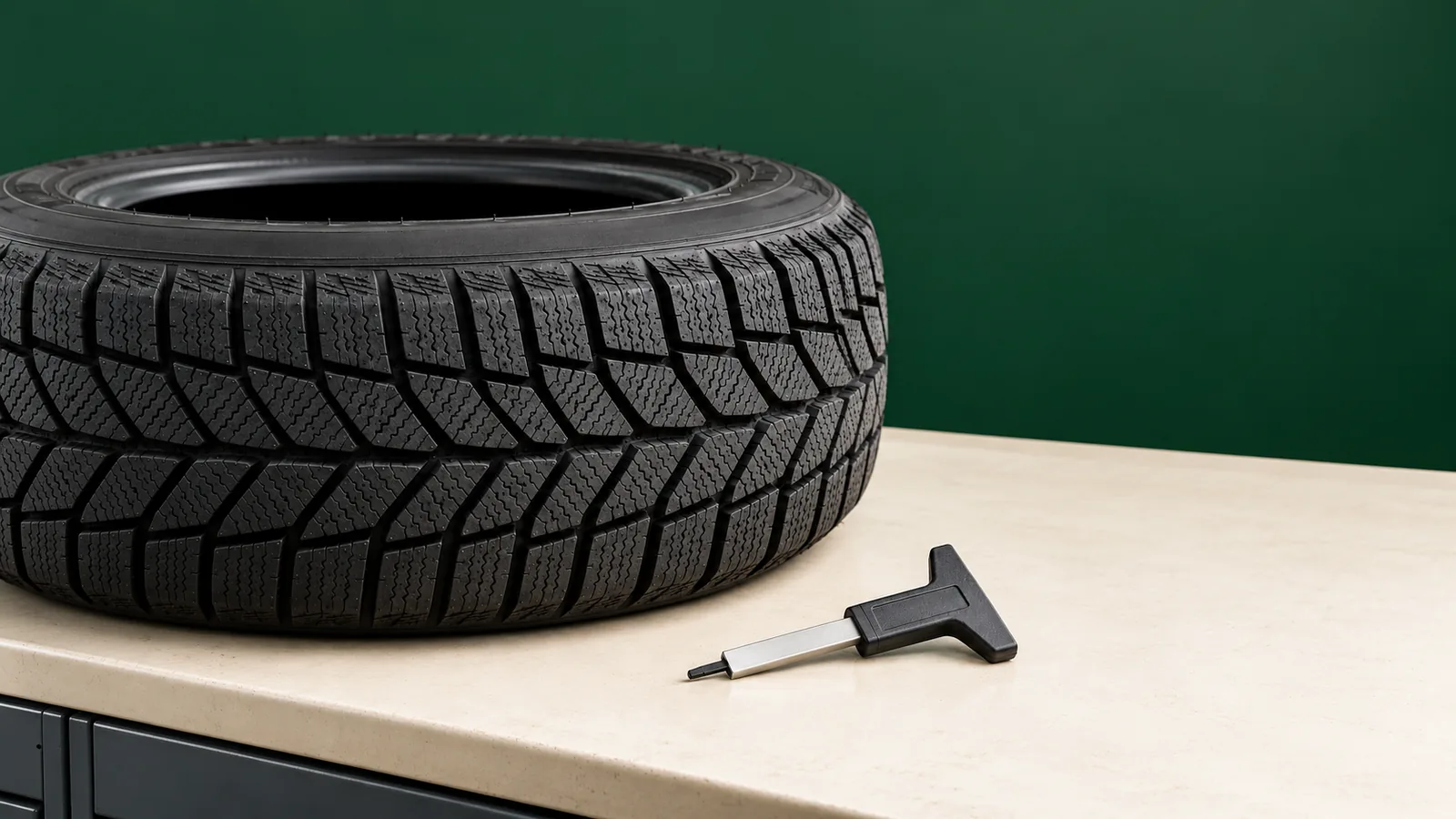
There are different indicators because they answer different questions. MLIT's daily-check guidance describes the ordinary slip sign associated with a remaining groove depth of 1.6 millimeters. Bridgestone explains a separate platform indicator for studless winter tires: the winter-use limit is reached when the tread has worn to fifty percent of its original depth. A driver should not merge those explanations into one universal inspection or snow-performance threshold. Having some groove remaining is not the same claim as retaining suitability for winter use.
Ask the workshop to identify the relevant indicators on your actual set, including tires stored away from the car. Photographs can help explain which set you mean, but they cannot measure every groove, reveal hidden damage or establish the condition of the whole tire. Uneven wear also matters: a picture of the deepest visible portion may not represent another part of the tread. Record the provider's observations and recommendation, rather than translating an online illustration into a pass decision.
The distinction is useful when comparing quotes. One proposal may concern a seasonal swap onto an existing set, while another may include replacing tires judged unsuitable for winter use. Those are different scopes. Ask what condition prompted replacement, which tires were assessed and what alternatives are being proposed. Do not dismiss the more expensive proposal solely because the first quote used the word 'change' without inspecting the stored set.
Source notes: 国土交通省:日常点検・タイヤの摩耗 ↗ · ブリヂストン:スタッドレスタイヤの使用 ↗
Prepare information about both tire sets
Describe the fitted set and the stored set separately. For each, identify whether it consists of loose tires or complete wheel assemblies, the markings you can safely read, where it has been kept and any previous professional advice. Do not assume a garage will accept customer-supplied tires, assess them without an appointment or store a second set automatically. Ask those questions before carrying bulky items to the premises. A clear inventory prevents a provider from quoting a simple wheel swap when you actually need tires mounted onto wheels.
Compatibility requires more than a similar-looking size. The vehicle's specification, wheel arrangement and necessary parts need appropriate checking. This guide intentionally does not provide fastening procedures or a do-it-yourself fitment decision. If you are unsure which components belong to the set, photograph or list them safely and ask the workshop what to bring. Avoid opening packages or disturbing equipment merely to create a more detailed enquiry when you do not understand the item.
Share information progressively. The initial conversation usually benefits from a model description, service request, timing and the broad condition of the stored set. Send identifying documents only through a suitable channel when a provider explains why they are needed. A winter tire enquiry does not require public posting of your inspection certificate or personal address. You can prepare accurate information without handing every private record to every workshop you compare.
Separate the work in a combined appointment
Break a combined quotation into inspection procedure, maintenance assessment, necessary repairs, seasonal tire or wheel work, proposed related services and storage. The phrase 'shaken with tire change' is too broad to compare on its own. It may describe moving a complete wheel set onto the vehicle, mounting tires onto wheels or replacing worn tires as well. Ask the provider to state the intended operation in ordinary language. If balancing or other work is recommended, ask why it is included and whether its cost is already in the total.
A combined visit also needs an approval process. Inspection or maintenance findings may change the scope after the car arrives. Agree how the workshop will explain additional work, who may approve it and what happens if you cannot respond immediately. Do not treat a broad instruction to 'prepare for winter' as unlimited authorization for every suggested purchase. You can prioritize required work while considering optional services separately, with the provider explaining the consequences of any decision.
Timing should be just as explicit as price. Confirm arrival time, assessment sequence, parts status and what the workshop expects to finish that day. A booked intake slot is not necessarily a guaranteed collection time. If same-day return is important, explain the need before booking and ask what contingency applies. 車検.jp does not have verified live workshop capacity and cannot promise completion, a discount or a replacement vehicle through this guide.
Plan alternatives before relying on one slot
Offer more than one possible date when the inspection window and seasonal wheel work overlap. You do not need to assume that every Japanese garage is busy, but you should verify the capacity of the specific workshop you plan to use. Ask whether separate appointments would produce a more reliable schedule than combining everything. A convenient-looking single visit may be less useful if it leaves no opportunity for necessary follow-up work before expiry.
Check the workshop's actual booking rules. Clarify what constitutes confirmation, how changes are handled, whether customer-supplied items must be declared and what happens if an assessment reveals additional work. Keep a short written record of the confirmed date and scope. If a booking platform is involved, distinguish its request process from the workshop's acceptance. An automated receipt may acknowledge your enquiry without confirming a bay, mechanic, parts allocation or final return time.
Create a fallback that is realistic for your household. It may be another date with the same provider, an earlier assessment or a separate seasonal service; it should not assume a second garage will accept a car immediately. Ask what records or quotations you would need for a transfer if that becomes necessary. This approach reduces avoidable delay without inventing availability. It also lets you compare the cost of flexibility, transport and time alongside the monetary service total.

Compare storage by its actual conditions
Storage is a separate service, not an automatic benefit of an inspection appointment. Ask what the provider accepts, how the period is defined, how charges are calculated and how early you must request retrieval. Bridgestone-related storage information provides an example of a service to investigate, not a guarantee that every retailer offers the same terms. Confirm the current contract with the branch that would actually hold your set, including how renewal, collection and a change of vehicle are handled.
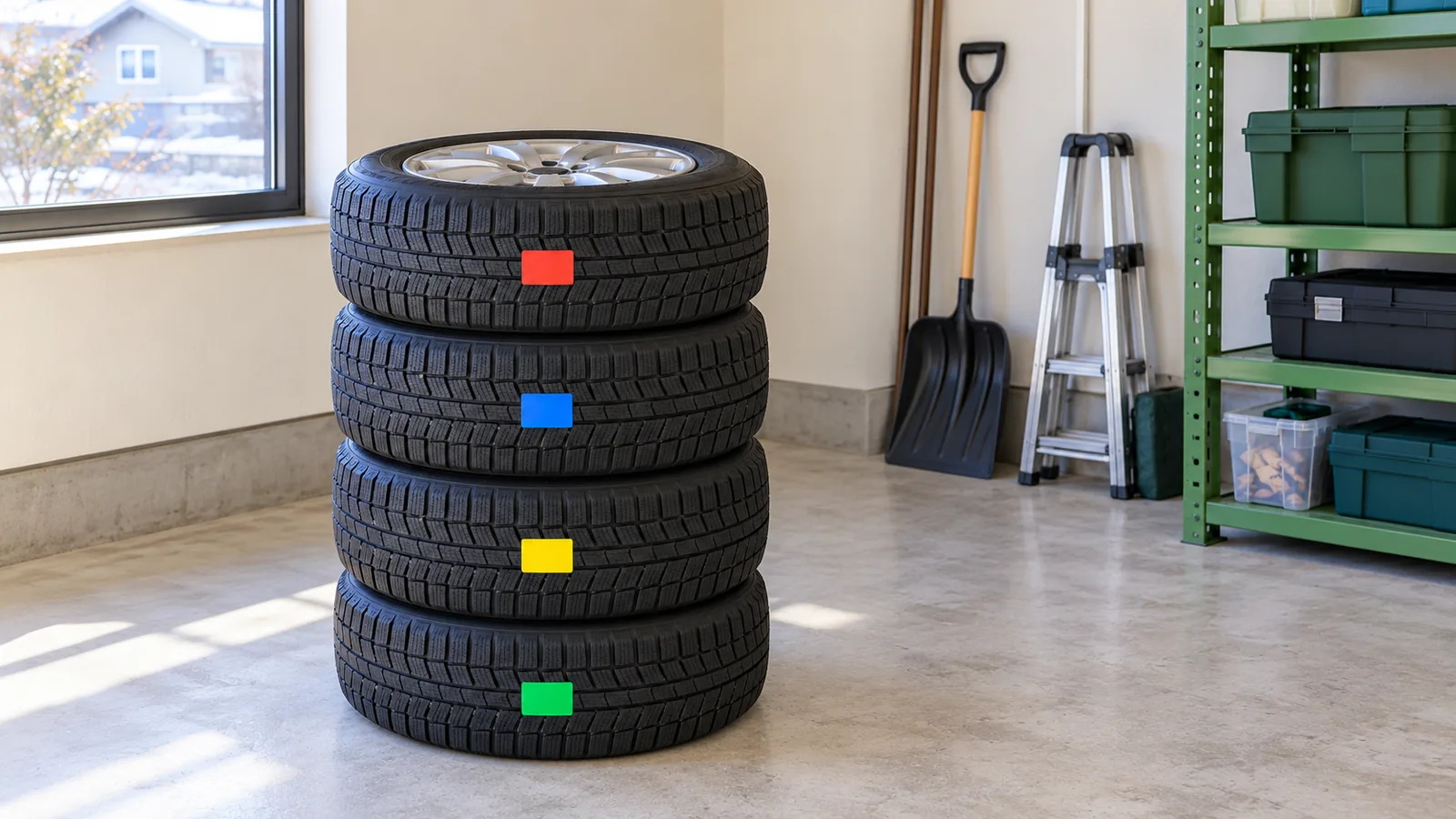
For home storage, follow the tire manufacturer's advice appropriate to your set. Conditions and arrangement matter, and loose tires should not automatically be treated like complete wheel assemblies. Avoid turning a stylized photograph of stacked wheels into a universal storage instruction. Ask about a suitable place, protection from heat and sunlight, and avoiding substances such as oil that can affect rubber. This article does not inspect your storage space or replace product-specific instructions.
Think ahead to retrieval as well as deposit. Record which set was handed over, its condition as described by the provider, how it will be identified and who can collect it. Before the next season, ask whether assessment occurs before installation and how unsuitable tires would be discussed. A paid storage arrangement is not a promise that a tire will remain usable indefinitely. You still need a condition check and an appropriate decision when the set returns to service.
Source notes: ブリヂストン:タイヤの保管 ↗ · ブリヂストン:タイヤ保管サービスの例 ↗
Use age as context, not a remote verdict
A tire's age is useful context for a professional discussion, but it is not a remote verdict of safety or an automatic universal replacement date. Read manufacturer lifespan advice together with its assessment recommendations and the tire's actual condition. Storage, damage, use and previous findings can all affect the conversation. Do not choose a particular number of years from an online comment and apply it to every tire as if it were an inspection rule.
If you received a set with a used vehicle, acknowledge what you do not know. You may have no reliable history of pressure, storage, impacts or past repairs. Tell the workshop about those gaps instead of creating an optimistic story from the previous owner's description. An assertion that the tires 'worked last winter' does not establish their suitability for your current vehicle and planned conditions. Nor does it show that every wheel or component supplied with the set belongs on your car.
Keep the recommendation specific. Ask which observation or manufacturer guidance supports any proposed replacement, whether all tires were assessed and what options are compatible with the vehicle. A useful explanation will connect the proposal to a condition or intended use. You can then compare equivalent options across providers without demanding that a remote calculator contradict an assessment it cannot perform. Our planning tools organize questions and budgets; they do not override a tire specialist's examination.
Source notes: ブリヂストン:使用期間と点検 ↗
Compare complete totals and unresolved charges
Use separate rows for statutory inspection costs, the workshop's service fee, additional maintenance, seasonal wheel work, any new tires or parts, storage and transport. Mark unresolved amounts as 'confirm with provider,' not zero. A missing fee is an unanswered question. If you add only known amounts, label the result as a subtotal so the screen does not give a false impression of a complete budget. Our comparison worksheet is designed to preserve those distinctions rather than select a winner from incomplete numbers.
When new tires are proposed, align specification and quantity before comparing price. Identify the intended product, compatible size, number supplied and the work included in fitting it. Ask about any separately charged disposal or related operations where relevant. Two estimates that use different products and mounting scopes cannot be compared fairly by their largest number alone. Likewise, storing a complete wheel set and storing loose tires may involve different arrangements that should remain visible in the quote.
Record discounts only after checking the provider's current eligibility and terms. A promotion advertised elsewhere may concern another branch, product, booking route or period. 車検.jp does not manufacture a coupon or guarantee the lowest market price. The immediate benefit here is a more accurate comparison and a clear list of unanswered questions. For some households, a reliable schedule and manageable collection plan may be more valuable than a small difference in the quoted service fee.

Include transport and collection in the plan
Plan how you will leave the workshop and return to collect the car. If you need a loan vehicle, ask whether one is available, whether a reservation is required and what charges, insurance arrangements and use conditions apply. Do not assume a loan car has equipment suitable for every winter journey you planned in your own vehicle. Explain those needs and ask the provider to clarify the actual vehicle and terms before relying on it.
Collection or delivery may be a separate service with its own conditions. Confirm who performs it, where handover occurs and how the car's condition and keys are documented. If relatives will collect the vehicle, ask what authorization or identification the workshop needs. Practical details are especially helpful when the appointment overlaps work, childcare or a journey away from home. A quotation that excludes transport may still be suitable, but you should know how that changes the overall plan.
If inspection validity has expired or you have a reason to doubt safe driving, do not build the plan around driving the car to a nearby workshop. Ask an appropriate professional about lawful and safe transport. Neither an online enquiry nor a winter tire appointment grants permission to use an expired vehicle on public roads. Resolve the transport question explicitly rather than letting it disappear beneath the convenience of a combined service booking.

Example: a Sapporo household arranging autumn work
Consider a hypothetical household in Sapporo whose inspection is due in autumn and whose winter set is stored on wheels. They need the car for work on weekdays. Their first useful message states the confirmed expiry, available dates, the stored set's arrangement and that its condition has not yet been assessed. They ask whether an advance check is possible and request two scheduling options: combined work or separate inspection and seasonal visits. This is an invented planning example, not a customer review or a claim about local appointment availability.
The household does not treat a wheel-swap estimate as the final cost before the stored tires are examined. Instead, they ask how replacement would be proposed if assessment finds a problem, what must be approved and whether parts timing could affect collection. They also ask about a loan vehicle and a fallback date. The provider's answers are recorded alongside the quote. Those details let the household compare a plan, rather than simply compare isolated service headlines.
If the workshop cannot confirm everything at once, the household keeps the uncertainties visible. It might be sensible to arrange an earlier assessment, but that depends on actual acceptance and timing. They do not assume another garage has instant capacity or that living in Sapporo creates an entitlement to a particular winter package. The location guide helps organize regional preparation; the selected workshop still needs to verify the vehicle, equipment and requested work.
Example: a Nagoya driver planning a winter trip
A second hypothetical driver lives in Nagoya but plans a winter trip to a mountain area. The home address does not fully describe the car's intended use. The driver tells the workshop where and when they expect to travel, asks about the tire set and necessary equipment, and separates that preparation from the inspection appointment. This makes the conversation more specific without pretending the workshop or this website can predict every road condition.
The driver avoids placing all assessment, purchasing and installation into one appointment immediately before departure. They leave time to confirm compatibility and obtain any agreed items. If an inspection finding requires further work, the journey plan must remain flexible. They also ask about collection arrangements so an unexpectedly longer service does not force an unsafe shortcut. A finished inspection and a scheduled trip are two separate facts; one does not automatically guarantee the other can go ahead.
Before leaving, the driver checks current relevant road and weather information and follows applicable instructions. This guide does not offer a blanket claim about chain requirements, access restrictions or traction on a particular route. Those issues depend on the road and conditions. The practical advantage of planning early is having time to respond to information and adjust travel, rather than seeking a reassuring statement that an inspection pass authorizes all winter driving.
Keep useful records after collection
At collection, review what was completed, which items were replaced and what was deposited into storage. Keep the inspection record and seasonal service documentation distinguishable. Ask about entries you do not understand, especially if the final invoice differs from the initial quotation. A record of the explanation and authorization helps you understand the work without claiming that every later issue would have been detectable at the appointment.
Follow the provider's instructions relevant to the fitted set and your vehicle. If they recommend a future check, ask what to arrange and when rather than translating that into an unsupported universal procedure. Record any remaining recommendation separately from work already performed. A signed collection document should not lead you to assume that optional items were completed when they were merely discussed. Clarity at this point prevents the next workshop from receiving an inaccurate service history.
Calendar tasks should also remain separate. Inspection expiry, a storage renewal date, retrieval notice and a seasonal condition check serve different purposes. You may set reminders, but a notification does not assess the tire, renew a storage contract or confirm a garage booking. After a change of provider or vehicle, review those reminders again. The aim is a dependable record that you control, not an assumption that an email service has taken responsibility for every future appointment.
Use local guides and the voluntary preparation pack
Our area guides help you organize location and preparation information before approaching a workshop. Japan Post's address data is a reference for postal locations; it is not proof of a partner garage, an available appointment or a storage service. Use a city page alongside the quotation worksheet and inspection-date planner, then verify the actual provider's conditions. The website does not turn broad nationwide address coverage into verified service coverage.
The free preparation pack is available on screen. If you voluntarily want an emailed copy, review the current form information and delivery status before requesting it. Necessary operator and privacy readiness checks must be satisfied before an email feature is activated. This guide does not claim that a saved address is confirmed, marketable or proof of vehicle ownership. Email confirmation and optional promotional consent have different purposes and should remain separate.
You can use the material without signing up. Prepare your dates, tire inventory, scope questions, unresolved cost lines and transport plan, then discuss them with the workshop you choose. That is a useful outcome even if you never request an email. A preparation service earns trust by making the decision clearer, not by hiding a basic answer behind a mandatory address field or promising a discount it cannot actually provide.
Source notes: 日本郵便:郵便番号データ ↗
FAQ: Winter tires and inspection scheduling
Does passing shaken mean winter tires are suitable for snowy roads?
No. Inspection compliance and winter-use condition are separate questions. Ask a qualified provider to assess the relevant indicators, damage and intended use. A general inspection result does not certify traction on every road or in every winter condition.
Can tire change and shaken happen on the same day?
Ask the actual workshop. It must confirm work scope, equipment, parts and timing. An enquiry receipt is not a guarantee of same-day completion, and 車検.jp does not have verified live capacity for every local provider.
Are ordinary slip signs and winter platform indicators identical?
No. They communicate different wear-related limits. Read the manufacturer's explanation for the tire and have the actual set assessed. Do not translate a remaining groove or an online photograph into an assurance of winter performance.
Can photographs establish that a stored set is usable?
Photographs can support an enquiry but cannot establish complete condition, hidden damage or compatibility. Provide accurate background and ask about an in-person assessment. Avoid selecting only an apparently good part of the tread as evidence for the whole set.
Must a garage accept customer-supplied winter tires?
No universal acceptance applies. Describe the set and ask about the provider's policy, assessment and fitment requirements before arriving. Acceptance of an enquiry is not approval to install an incompatible or unsuitable item.
Is tire storage included in an inspection quotation?
Not automatically. Check scope, period, retrieval notice, renewal and charges as separate conditions. A service advertised by one provider does not establish that another branch or workshop offers the same arrangement.
Does a particular tire age always require replacement?
Do not use age alone as a universal inspection verdict. Consult manufacturer advice and a condition assessment that considers use, storage and damage. An unknown history should be disclosed instead of replaced with assumptions from a previous owner.
Is the two-month inspection window the same as sixty days?
No. Treat the general window as two calendar months and confirm the applicable procedure using the current vehicle record and official guidance. Planning tools should not silently substitute a fixed number of days for a calendar rule.
May an expired car be driven to a nearby tire workshop?
Proximity is not permission to drive on public roads. Seek appropriate advice about lawful and safe transport. A seasonal service appointment or online booking request does not renew inspection validity or resolve a safety concern.
Must I provide an email to use the preparation pack?
No. On-screen preparation information remains available. An emailed copy is voluntary and depends on the service's current readiness. Email confirmation is separate from optional marketing consent and does not verify car ownership or winter-service eligibility.
References and primary sources
Checked: 2026-10-05. Confirm current procedures, prices and conditions with the official source and workshop. Hypothetical amounts and scenarios are not market-price guarantees or customer results.
- 国土交通省:日常点検・タイヤの摩耗 ↗
- ブリヂストン:スタッドレスタイヤの使用 ↗
- ブリヂストン:タイヤの保管 ↗
- ブリヂストン:使用期間と点検 ↗
- ブリヂストン:タイヤ保管サービスの例 ↗
- 国土交通省:継続検査の2か月前受検 ↗
- 日本郵便:郵便番号データ ↗
General preparation guidance. This is not an individual vehicle assessment. See our editorial policy for sources and corrections. Editorial policy →
Turn the guide into a plan.
Organize confirmed conditions and prepare the questions for your workshop.
Open the free tool